 Inverity
AI Images in Production: Will Your Optimizer Get You Fined?
Date Published
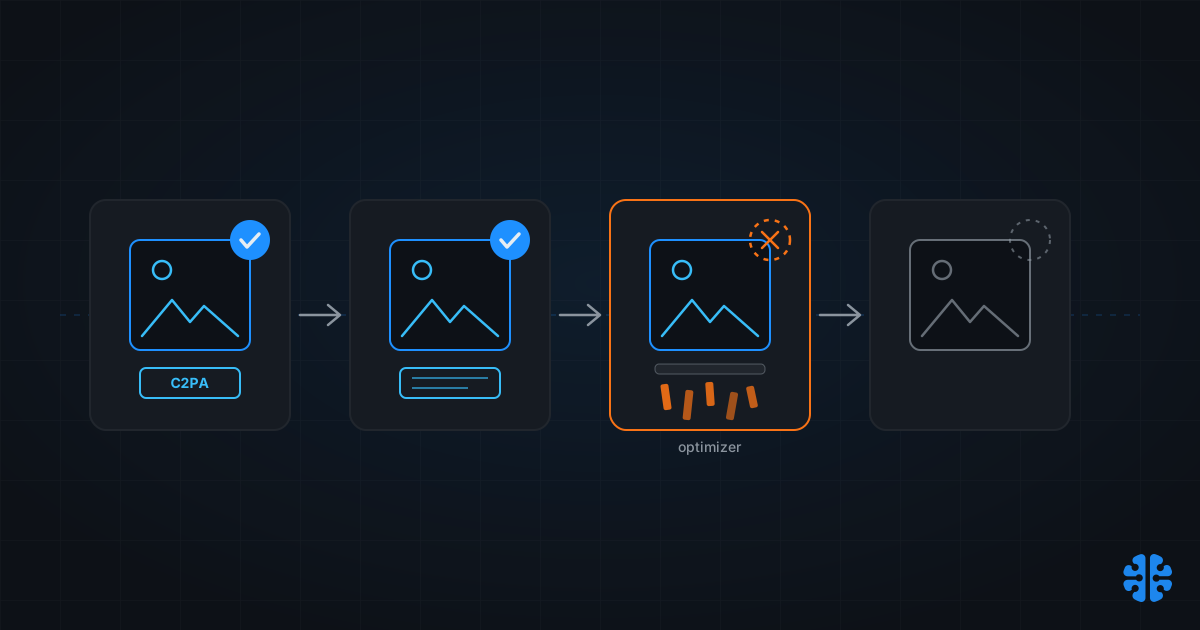
Ten days from now, on August 2, 2026, the EU AI Act's Article 50 transparency obligations become applicable, requiring machine-readable marking of AI-generated content and labeling of deepfakes (European Commission, 2025-26). Most image optimization pipelines, meanwhile, still do what they've done for fifteen years: strip every byte of metadata on ingest, including the provenance credentials that the marking regime depends on.
The industry has spent two years debating whether AI images are good. The operational question is narrower and more urgent: when an AI image enters your CMS, survives your optimizer, and exits your CDN, does anything still say what it is?
TL;DR
- EU AI Act Article 50 (machine-readable marking of AI content, deepfake labeling) applies from August 2, 2026; the Commission published draft implementation guidelines on May 8, 2026 (European Commission, 2026).
- Volume is not hypothetical: ChatGPT users generated 700M+ images in roughly nine days after 4o image generation launched (TechCrunch, 2025); Adobe Firefly passed 22 billion generated assets (Adobe, 2025).
- C2PA Content Credentials live in metadata, and metadata stripping is the default in most optimizers and CDN "auto" modes. A C2PA manifest costs single-digit kilobytes against a ~900 KB median image payload.
- Peer-reviewed research shows JPEG compression erases the statistical fingerprints that distinguish AI images from photos (Scientific Reports, 2025). Compression and provenance are in direct tension.
- SynthID and C2PA are complementary, not competitors: pixel-level watermark versus signed manifest. Most coverage blurs this.
What does the EU AI Act actually require by August 2, 2026?
Article 50 requires that AI-generated and manipulated content be marked in a machine-readable format, and that deepfakes be disclosed. It applies from August 2, 2026. The Commission published a draft Code of Practice on AI-generated content on December 17, 2025, and draft implementation guidelines on May 8, 2026 (European Commission, 2025-26).
Note what "machine-readable marking" implies for a media pipeline. It is not a caption. It is not a line in your terms of service. It is a signal attached to the asset itself that software can detect. The two production-grade mechanisms for that signal today are C2PA manifests (signed metadata) and imperceptible watermarks like SynthID. Both can be destroyed downstream, one far more easily than the other.
The platforms moved before the regulators finished. YouTube has required creator disclosure of realistic synthetic content since March 2024, with labels made more prominent through 2025-26 (YouTube, 2024-26). Meta has applied "AI Info" labels across Facebook and Instagram since early 2024, keyed to industry signals like C2PA and IPTC metadata plus self-disclosure (Meta via KINESSO, 2024-25). If your pipeline strips the signals those systems read, you haven't opted out of labeling. You've opted into unlabeled, which is the worse category to be in after August 2.
How many AI images are actually flowing through production pipelines?
More than most DAM audits assume. ChatGPT users generated over 700 million images in roughly nine days after GPT-4o image generation launched in March 2025, with 130M+ users and a peak near 100 million images per day (TechCrunch, reporting OpenAI's COO, 2025).
Adobe Firefly passed 22 billion cumulative generated assets by April 2025, roughly 24 billion by mid-year (Adobe Newsroom, 2025). And the oldest widely-cited baseline, Everypixel's estimate of about 34 million AI images per day and 15 billion cumulative, dates to August 2023 (Everypixel Journal, 2023). Treat that figure as a floor from three years ago, not a current rate. These counts also aren't directly comparable to each other; they measure different products over different windows. The honest summary is directional: generation volume is enormous and grew explosively through 2025.
For a marketing organization, the operational consequence is simple. You can no longer assume the assets entering your upload-to-delivery pipeline are camera-origin. Some fraction is generated, and under Article 50 that fraction needs to stay identifiable at the point of delivery, not just at the point of creation.
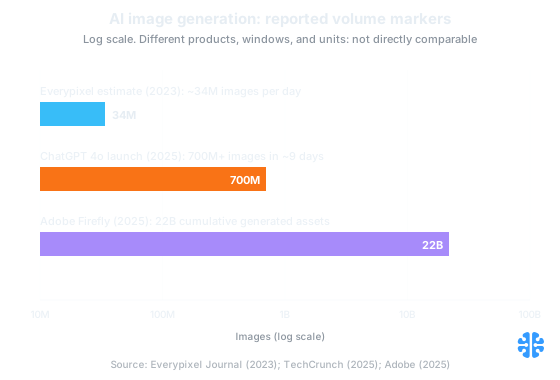
Reported AI image generation volumes, log scale; the markers cover different products, windows, and units, so read them directionally (Everypixel Journal, 2023; TechCrunch, 2025; Adobe, 2025).
Why does your optimizer strip provenance by default?
Because for fifteen years, metadata was dead weight. EXIF, XMP, and IPTC blocks added kilobytes with no rendering value, so mozjpeg, sharp, and virtually every CDN "auto-optimize" mode strip them by default. That default was correct for performance. It is now a compliance liability, because C2PA Content Credentials live in exactly the metadata those tools discard.
The economics of keeping them are trivial. A C2PA manifest typically costs single-digit kilobytes against a median image payload around 900 KB. Nobody's Core Web Vitals budget dies on a 5 KB signed manifest. The problem isn't cost; it's that the strip-everything default was set before provenance metadata existed, and almost nobody has revisited it.
The provenance ecosystem on the creation side is genuinely mature. The C2PA Technical Specification reached v2.2 on May 1, 2025 (C2PA, 2025), and a Conformance Program launched the same year, moving from phased self-assertion toward certification (C2PA via Trust Over IP, 2025). Adobe Firefly, OpenAI's DALL-E 3 and 4o, and Microsoft Bing Image Creator write credentials at generation. On the capture side, signed provenance ships in the Leica M11-P (first, October 2023), Sony Alpha bodies via firmware, Nikon Z9/Z8 firmware, with Canon announced for the EOS R1 and R5 Mark II. Creation signs. Delivery shreds. The weak link is the middle of your pipeline, and it is a governance problem before it is a technical one.
Do Content Credentials survive compression and re-encoding?
Often not, and this is documented rather than speculative. IPTC's guidance and Tim Bray's independent testing both found that C2PA credentials generally do not survive social platform re-encodes (Tim Bray, C2PA Investigations, 2025). Any pipeline stage that rewrites the file without C2PA awareness produces a clean, credential-free image.
C2PA's answer is durable Content Credentials: a soft-binding watermark or fingerprint computed from the pixels themselves, paired with a manifest repository, so a stripped credential can be re-matched and re-attached later. It's a sound design, but it depends on tooling adoption at every hop, and in July 2026 you should assume most hops don't have it.
The deeper tension is physical, not organizational. A 2025 peer-reviewed study in Scientific Reports found that JPEG compression significantly erases the high-frequency statistical fingerprints that distinguish AI-generated images from photographs (Scientific Reports, Nature Portfolio, 2025). Aggressive quantization doesn't just risk the metadata label; it degrades the forensic signal detectors would use as a fallback. Every recompression pass makes the "is this AI?" question harder to answer from pixels alone. This is one more reason blanket compression settings are the wrong tool: provenance-bearing assets need different handling than anonymous decorative images, and a pipeline that can't distinguish them can't comply selectively either.
AI images do have one genuinely convenient property: diffusion outputs lack sensor noise and contain smoother, low-entropy regions, so they typically compress smaller than photographs at equal resolution. But their fine repetitive textures degrade fast under aggressive quantization. Smaller files, narrower safe operating range.
SynthID and C2PA solve different problems
They solve different failure modes, and most articles blur them into a single "AI watermarking" story. C2PA is a cryptographically signed manifest: rich, verifiable, and destroyed by any tool that rewrites the file without preserving it. SynthID, Google's approach, is a pixel-level watermark: invisible, carrying far less information, but it survives modest compression because it lives in the image data itself. Google joined the C2PA steering committee in 2024 precisely because the two are complementary.
| C2PA Content Credentials | SynthID |
|---|---|---|
Mechanism | Signed manifest in metadata | Imperceptible pixel-level watermark |
Information carried | Rich: tool, edits, signer identity | Minimal: essentially "AI-generated" |
Verifiable by third parties | Yes, cryptographically | Requires detector access |
Survives metadata stripping | No (unless durable/re-attached) | Yes |
Survives modest recompression | Manifest lost if file rewritten | Generally yes |
Who writes it | Firefly, DALL-E 3/4o, Bing Image Creator; signing cameras | Google's generation models |
A defensible Article 50 posture uses both where available: preserve the manifest, and don't recompress so aggressively that you destroy watermark or forensic signal.
What should your pipeline actually do? A checklist
Ten days out, here is the audit we'd run, in order:
- Inventory the strip points. Test one Firefly or DALL-E image through your real pipeline: CMS ingest, DAM transforms, optimizer, CDN. Verify the C2PA manifest at each hop with the open-source tooling (c2pa-rs, c2pa-node, or the CAI JS SDK: opensource.contentauthenticity.org).
- Change the optimizer default from "strip all metadata" to "strip EXIF/GPS, preserve C2PA/XMP provenance blocks." If your tool can't express that distinction, that's a finding.
- Re-sign after transformation. A resize or format conversion invalidates the original manifest by design. C2PA supports appending a new signed action to the chain; your pipeline should re-sign as part of the transform, not treat the broken seal as acceptable loss.
- Tag provenance-bearing assets in the DAM so governance policy can apply different compression ceilings to them.
- Cap recompression aggressiveness on AI-origin assets, given the forensic-erasure finding.
- Don't rely on your CDN's defaults to have solved any of this. As a rule, it hasn't.
FAQ
Do AI images keep their Content Credentials after my CDN compresses them?
Usually not, by default. Most optimizers and CDN auto modes strip all metadata, and independent testing (Tim Bray, 2025) shows credentials generally don't survive re-encodes. You must explicitly configure metadata preservation, or re-sign after transforms. Durable Content Credentials (watermark plus manifest repository) are C2PA's recovery mechanism.
What does the EU AI Act actually require for AI images by August 2026?
Article 50 requires machine-readable marking of AI-generated content and disclosure of deepfakes, applicable from August 2, 2026 (European Commission, 2025-26). A draft Code of Practice (December 2025) and draft Commission guidelines (May 2026) detail implementation. Practically: keep C2PA or equivalent signals intact through delivery.
Do AI-generated images compress better or worse than photographs?
Smaller, but more fragile. Diffusion outputs lack sensor noise and have smoother low-entropy regions, so they compress smaller at equal resolution. But fine repetitive textures degrade quickly under aggressive quantization, and recompression erases forensic fingerprints (Scientific Reports, 2025). Use moderate settings, not maximum squeeze.
How do I add C2PA Content Credentials in my CMS or DAM workflow?
Use the open-source Content Authenticity tooling: c2pa-rs (Rust), c2pa-node, or the CAI JS SDK (opensource.contentauthenticity.org). Sign at ingest or after each transform, appending actions to the manifest chain. The C2PA v2.2 spec (May 2025) and the new Conformance Program define what compliant implementations look like.
Will Meta, YouTube, or Google penalize unlabeled AI images?
The current regimes are labeling regimes, not ranking penalties. Meta applies "AI Info" labels using C2PA/IPTC signals plus self-disclosure (since early 2024); YouTube requires disclosure of realistic synthetic content (since March 2024) with increasingly prominent labels (YouTube, 2024-26). Stripping signals means platforms guess, and undisclosed synthetic content is where enforcement bites.
The ten-day version
You don't need a provenance strategy document by August 2. You need to know three things: which pipeline stage strips credentials, whether your optimizer can preserve or re-sign them, and which of your delivered assets are AI-origin. That's one test image and an afternoon.
At Inverity this maps onto a principle we apply to everything: an optimization you can't verify end-to-end isn't an optimization, it's a hope. Provenance just makes the stakes legible, and now regulatory. The pipelines that win the next two years won't be the ones that compress hardest. They'll be the ones that can prove what they did to every image they touched.