 Inverity
Alt Text at Scale: Accessibility as an Engineering Problem
Date Published
The accessibility industry spent a decade telling itself a comforting story: awareness is growing, tooling is improving, and the numbers, however bad, are slowly getting better. In March 2026, that story broke. The web's accessibility failure rate went up, not down, and missing alt text sits near the center of the regression.
The cause isn't indifference. It's throughput. Modern CMS and DAM pipelines publish more images, faster, with less human review than at any point in the web's history. That makes alt text a pipeline engineering problem, not a content-editor discipline problem. Treating it as the latter is why the numbers just reversed.
TL;DR >- 95.9% of the top one million home pages had detected WCAG 2 failures in 2026, up from 94.8% the year before, reversing years of slow improvement (WebAIM Million 2026).- 53.1% of home pages contained images missing alt text; pages now average 66.6 images each, up 13.6% year over year (WebAIM Million 2026).- Enforcement is real on both sides of the Atlantic: 5,114 US ADA digital lawsuits in 2025 (UsableNet, 2026) and formal EAA legal notices in France within days of the June 2025 deadline (Pivotal Accessibility, 2025).- Peer-reviewed evidence says AI alt text works when you inject page and product context, and fails confidently when you don't. The fix is architectural: context-aware generation plus human QA sampling in the media pipeline.
The 2026 WebAIM data: worse across the board
It showed a reversal. 95.9% of the top one million home pages had detectable WCAG 2 failures in 2026, up from 94.8% in 2025, ending years of slow improvement (WebAIM Million 2026). For images specifically, 53.1% of home pages contained at least one image missing alt text.
The per-page numbers explain the direction of travel. The average home page now carries 66.6 images, a 13.6% increase in a single year, and 56.1 detectable errors, up 10.1% (WebAIM Million 2026). Overall page complexity hit 1,437 elements per page, up 22.5% year over year. Pages are getting heavier and more automated, and accessibility review is not keeping pace.
Metric (top 1M home pages) | 2025 | 2026 | Direction |
|---|---|---|---|
Pages with detected WCAG 2 failures | 94.8% | 95.9% | Worse |
Pages containing images missing alt text | — | 53.1% | — |
Images per home page (avg) | — | 66.6 (+13.6% YoY) | Worse |
Detectable errors per page (avg) | — | 56.1 (+10.1% YoY) | Worse |
Elements per page (avg) | — | 1,437 (+22.5% YoY) | Worse |
Source: WebAIM Million 2026; year-over-year changes as reported by WebAIM. See the 2025 report for the prior-year baseline.
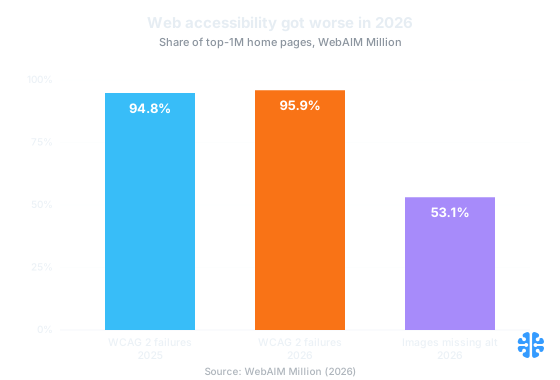
WCAG 2 failure rates reversed course in 2026, and over half of home pages ship images missing alt text (WebAIM Million 2026).
The 2025 baseline adds a detail that should worry anyone running an e-commerce catalog. That year, 18.5% of all images lacked alt text, and 44% of those were linked images (WebAIM Million 2025). A linked image without alt text isn't just an unlabeled picture. It's a link a screen reader cannot announce at all. Roughly one in five linked images fell into that category. For a product grid, that means entire purchase paths go silent.
Why is accessibility getting worse, not better?
Because image volume is outrunning human review. WebAIM attributes the 2026 reversal to rising page complexity and automated, framework-generated code (WebAIM Million 2026). More images, shipped faster, through pipelines where no human ever looks at the markup. The failure is structural, and structural failures don't respond to awareness campaigns.
Consider what a modern publishing stack does. A DAM ingests thousands of assets from photo shoots, agencies, and AI generation tools. A CMS pulls renditions through templates. Components assemble pages nobody hand-codes. At each hop, the alt attribute is either propagated from metadata or silently dropped. In our experience, it's usually the latter, because alt text was never modeled as a first-class field with governance rules attached.
This is the same class of problem as image compression policy: defaults applied at scale without per-asset judgment. We've written before about why that fails for quality in why blanket compression hurts your CMS, and the accessibility version is worse, because the people harmed can't see the degradation happening.
The uncomfortable conclusion: any accessibility strategy that depends on editors remembering to fill in a field will lose to a pipeline shipping 66 images per page. The fix has to live in the pipeline itself.
What does enforcement look like after June 2025?
Enforcement moved from theoretical to operational on both continents. The European Accessibility Act became enforceable on June 28, 2025, with member-state penalties reaching roughly €100,000 per violation or linked to revenue (Greenberg Traurig, 2025). In the US, 5,114 ADA digital accessibility lawsuits were filed in 2025 (UsableNet, 2026).
The EU moved faster than skeptics predicted. Within days of the June 2025 deadline, French disability organizations served formal legal notices on four major grocery retailers, and first-year enforcement has included market-surveillance inspections, not just complaint responses (Pivotal Accessibility, 2025). EAA conformance is assessed against EN 301 549, which incorporates WCAG 2.1 AA, so a missing alt attribute is a direct, machine-detectable compliance gap.
The US numbers show concentration, not randomness. Federal filings rose 27% year over year, from 2,452 to 3,117 (UsableNet, 2026). E-commerce absorbed roughly 70% of digital accessibility lawsuits in 2025, and about 46% of federal cases hit repeat defendants (UsableNet, 2025). Repeat defendants are the tell: companies that settled once without fixing their pipeline got sued again. Settlement costs circulate as industry estimates only, but the repeat-defendant rate is the number that should drive engineering priorities. A settlement without a pipeline fix is a subscription.
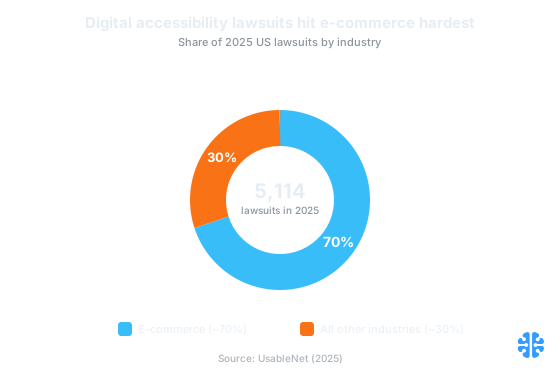
Roughly 70% of the 5,114 US digital accessibility lawsuits filed in 2025 targeted e-commerce (UsableNet, 2025).
One scope note that surprises US teams: the EAA applies to companies selling into the EU market regardless of where they're headquartered, with a narrow exemption for micro-enterprises under 10 employees and €2M revenue (Greenberg Traurig, 2025).
Can AI write alt text that actually works?
Yes, conditionally, and the condition is context. AltGen, a peer-reviewed generative framework for EPUB alt text, reduced accessibility errors by 97.5% with descriptiveness rated 4.8 out of 5 (ACM AICI 2025). The lever wasn't a bigger model. It was giving the model something beyond raw pixels.
A second study makes the mechanism explicit. On a healthcare site, AI alt text generated with up to 1,500 characters of surrounding page context outperformed both developer-written alt text and context-free AI alt text (IJSR, 2025). The image alone is ambiguous. A photo of a person at a desk could be "telehealth consultation" or "billing department contact." The surrounding copy resolves the ambiguity, and models given that copy write alt text that reflects what the image is for, not just what it depicts.
This should reframe how CMS and DAM teams see their metadata. Product names, captions, adjacent paragraphs, structured attributes: your system already holds the context that turns generic AI descriptions into accurate ones. Piping it into generation is an integration task, not a research problem. It's also a governance question, one we've covered from the policy side in AI governance in marketing technology.
Now the honest caveat. Research from CHI 2024 documents that AI-generated descriptions can be confidently wrong, delivering fluent, plausible text that misstates what's in the image, and screen reader users have no independent way to catch the error (ACM CHI 2024). A wrong description can be worse than a missing one, because it removes the user's awareness that information is absent. Fully automated alt text with no human verification doesn't eliminate risk. It converts a detectable gap into an undetectable one.
Building an alt text pipeline that scales
Treat alt text like any other rendition your pipeline produces: generated automatically, validated statistically, and owned by an accountable system rather than by whoever uploaded the file. The blueprint has four stages, and the evidence above dictates the design of each one.
1. Model alt text as structured data at ingest. Alt text belongs in the DAM as a first-class, per-asset, per-context field, with decorative as an explicit state that renders alt="" rather than an empty field that renders nothing. WCAG 2.2 SC 1.1.1 requires a text alternative for all non-text content, with empty alt reserved for genuinely decorative images (W3C WCAG 2.2, 2023). If your schema can't distinguish "decorative" from "nobody filled this in," your audits can't either. This is a schema and policy decision, the same territory as DAM governance for optimization.
2. Generate with context injection. When an asset lacks alt text, generate it using the model plus every piece of context the system holds: product title, category, caption, surrounding copy from the page requesting the rendition. The healthcare-site evidence puts useful context at up to 1,500 characters (IJSR, 2025). Context-free generation is the configuration the research specifically warns against.
3. Sample for human QA, weighted by risk. You can't review 66 images per page by hand, and you don't need to. Review a statistical sample, and weight the sampling toward the failure classes that matter: linked images (the unannounceable-link problem), product imagery (70% of lawsuits), and images where the model reports low confidence. Track a measurable error rate per model version and per template, and gate deployments on it.
4. Block regressions in CI. Missing alt on a linked image should fail a build the way a broken import does. Automated checks catch the presence gap; the QA sample catches the correctness gap. You need both, because the CHI 2024 finding means presence alone is a vanity metric.
None of this is exotic. It's the same generate-measure-verify loop that mature teams already run for image quality and performance, pointed at a different output. The teams treating accessibility as an editorial virtue are the ones going backward in WebAIM's data. The teams treating it as pipeline engineering are the ones who won't be repeat defendants.
At Inverity, we think alt text belongs in the same verifiable pipeline as compression and quality measurement: every generated description traceable to its context inputs, every batch carrying a sampled, human-verified error rate. A claim of "accessible" that nobody can audit is not a claim. It's an advertisement.
FAQ
Is alt text legally required in the US and EU?
Effectively, yes. US courts apply the ADA to websites, and 5,114 digital accessibility lawsuits were filed in 2025 (UsableNet, 2026). In the EU, the EAA has been enforceable since June 2025 against EN 301 549, which incorporates WCAG 2.1 AA, where missing alt text is a direct failure.
What does WCAG 2.2 actually require for images?
SC 1.1.1 (Level A) requires a text alternative for all non-text content that serves an equivalent purpose (W3C WCAG 2.2, 2023). Decorative images must carry an explicit empty alt="" so screen readers skip them. WCAG also restricts images of text (SC 1.4.5) and requires 3:1 contrast for meaningful graphics (SC 1.4.11).
Can AI-generated alt text make my site compliant, or will it create new risk?
Both, depending on architecture. Context-aware generation measurably outperforms developer-written alt text, and AltGen cut accessibility errors 97.5% (ACM AICI 2025). But AI descriptions can be confidently wrong (ACM CHI 2024), so unreviewed automation trades a detectable gap for an undetectable one. Keep human QA sampling in the loop.
How long should alt text be, and should it include keywords?
Long enough to convey the image's purpose in its context, typically a sentence or two. Front-load meaning rather than stuffing keywords: alt text exists for users first, and keyword-stuffed alt reads as spam to both screen readers and search engines. The context surrounding the image should drive the wording, which is exactly why context-injected generation outperforms (IJSR, 2025).
Does the European Accessibility Act apply to US companies selling into the EU?
Yes. The EAA applies to products and services placed on the EU market regardless of the provider's headquarters, with penalties up to roughly €100,000 per violation depending on member state (Greenberg Traurig, 2025). Only micro-enterprises (under 10 employees and under €2M revenue) are exempt for services.