 Inverity
Cloudinary vs imgix vs ImageKit: An Honest 2026 Comparison
Date Published
Search for "Cloudinary vs imgix" and the top results are written by Cloudinary. Search the reverse pairing and ImageKit's alternative pages appear. The most-read comparisons of these three platforms are marketing artifacts written by the contestants, and it shows: no real pricing math, no scenarios, no admission that the writer's product ever loses.
Disclosure, before anything else: Inverity competes in this space. We build adaptive media infrastructure, which makes us a rival to all three companies below. You should apply the same skepticism to this post that we apply to their /vs/ pages. Our defense is method: every pricing number here comes from the vendors' own live pricing pages as of July 2026, every calculation is shown, and the "when to choose them instead" sections are genuine. Disclosure beats pretense. This will be the only mention of us.
What follows is the comparison we wished existed: the three pricing models decoded, worked cost scenarios at two traffic tiers, honest failure modes from user reviews, and a decision framework that sometimes points away from all three.
TL;DR >- Entry paid tiers span an 11x range as of July 2026: ImageKit $9/mo, imgix $25/mo, Cloudinary $99/mo (vendor pricing pages: ImageKit, imgix, Cloudinary)- The real differentiator is the pricing model: Cloudinary uses blended credits, imgix uses storage-weighted credits (2 credits/GB storage vs 1/GB bandwidth), ImageKit uses flat per-GB overages- In our worked scenario at 100 GB delivered/month, costs land at roughly $43 (ImageKit), $75 (imgix, plus your own S3 bill), and $99 (Cloudinary), as of July 2026- imgix has no permanent free tier, only a 30-day trial; ImageKit's free tier is 20 GB bandwidth/month forever; Cloudinary's is 25 credits/month- By detected deployments, Cloudinary is roughly 1.4x more common than imgix and about 5x more common than ImageKit (wmtips crawler data, Feb 2026)
What actually separates Cloudinary, imgix, and ImageKit?
Architecture and ambition, not transformation features. All three resize, crop, convert formats, and auto-compress competently. The real split: Cloudinary is a full media platform with managed storage, video transcoding, DAM, and AI tagging; imgix is render-on-demand processing layered over storage you already own; ImageKit is optimization plus a lightweight DAM, positioned on price transparency.
That storage model is load-bearing, and it is the first question to answer before comparing anything else. With imgix, your images stay in your S3 or GCS bucket, imgix fetches from it as an origin, and you keep paying your cloud provider for storage. That is genuinely attractive if your asset library and its permissions already live in S3 and you do not want a second system of record. Cloudinary and ImageKit both offer managed storage, and ImageKit also supports external origins, giving it a foot in both camps.
The ambition split matters for evaluation, too. If you need video transcoding, deep asset management, and AI-driven tagging in one contract, Cloudinary is playing that game alone among these three; imgix offers minimal asset management by deliberate design. If you need images delivered fast and bills you can predict, the heavyweight platform may be capability you rent but never use. A transformation demo will not reveal any of this, which is why feature-checklist comparisons mislead: the platforms differ most in what happens around the transformation, not in it. That pattern, tools converging on features while diverging on architecture, is one we've written about in why your CDN isn't solving your image problem.
As of July 2026 | Cloudinary | imgix | ImageKit |
|---|---|---|---|
Scope | Full media platform: images, video transcoding, DAM, AI tagging | URL-based render-on-demand over your existing storage | Optimization + lightweight DAM + video |
Storage model | Managed | Your origin (S3/GCS); you keep paying your cloud bill | Managed, plus external origins supported |
Free tier | 25 credits/mo | None (30-day, 100-credit trial) | 20 GB bandwidth/mo, 3 GB storage, forever |
Entry paid tier | $99/mo (Plus) | $25/mo (Starter) | $9/mo (Lite) |
Pricing model | Blended credits | Storage-weighted credits | Flat per-GB with metered overages |
G2 rating (approx., live) | ~4.4/5 | ~4.1/5 | ~4.7/5 |
Sources: vendor pricing pages, July 2026 (Cloudinary, imgix, ImageKit); G2 reviews (Cloudinary, imgix, ImageKit), ratings approximate as of July 2026.
Three pricing models, three different bets
Three different abstractions, in increasing order of legibility: Cloudinary blends everything into one credit, imgix weights credits by resource type, and ImageKit skips the credit abstraction entirely for per-GB pricing. Understanding which resources dominate your bill under each model matters more than the sticker prices, because the models punish different usage shapes.
Cloudinary: blended credits. One credit equals "1000 transformations or 1GB managed storage or 1GB viewing bandwidth or 500 SD video seconds or 250 HD video processing seconds" (verbatim from Cloudinary's pricing page, July 2026). Plans: Free at 25 credits, Plus at $99/mo for 225 credits, Advanced at $249/mo for 600 credits, then custom Enterprise. The blend is elegant for mixed workloads and hard to forecast for everyone else: storage, bandwidth, and processing draw from one pool, so a traffic spike and a bulk re-transformation compete for the same credits. Note also what the tier list implies: there is nothing between $0 and $99.
imgix: storage-weighted credits. Storage costs 2 credits per GB per month; bandwidth costs 1 credit per GB (imgix pricing, July 2026). Starter is $25/mo for 100 credits with $0.25/credit overage; Basic $75 for 375; Midrange $150 for 830; Growth $300 for 1,875; Growth Plus $500 for 3,570. The 2:1 weighting means large, cold asset libraries are expensive relative to hot, small ones, and remember your own S3 bill continues in parallel. imgix is also the only one of the three with no permanent free tier: a 30-day, 100-credit trial, then you pay.
ImageKit: flat per-GB. Lite at $9/mo includes 40 GB bandwidth with $0.50/GB overage and 10 GB storage at $0.10/GB overage. Pro at $89/mo includes 225 GB bandwidth ($0.45/GB overage), 225 GB storage, 5,000 video units, and unlimited AI operations (ImageKit plans, July 2026). No credit conversion table required: you can compute next month's bill with multiplication. ImageKit is the only vendor of the three with transparent pay-per-GB overages instead of a credit abstraction, and it shows in forecastability.
Why do credit systems exist at all? Charitably, they let mixed media workloads share one number. Less charitably, they make comparison shopping require a spreadsheet, which benefits whoever owns the abstraction. We hold vendors' opacity, including the temptation toward our own, to the standard laid out in why most image optimization tools are lying to you: if you cannot recompute the bill from public numbers, that is a design choice.
What does each platform cost at 100 GB and 500 GB per month?
Run the math and the 11x sticker spread compresses but does not close: at 100 GB delivered monthly, expect roughly $43 for ImageKit, $75 for imgix plus your S3 bill, and $99 for Cloudinary, using each vendor's published July 2026 rates. At 500 GB, Cloudinary's public tiers run out entirely.
Our assumptions, so you can check the work. Scenario A: 100 GB delivered, 50 GB stored, 10,000 transformations per month. Scenario B: 500 GB delivered, 200 GB stored, 50,000 transformations. Real workloads vary; substitute your own numbers into the same arithmetic.
Scenario A, worked:
- Cloudinary: 100 GB bandwidth = 100 credits, 50 GB storage = 50 credits, 10k transformations = 10 credits. Total 160 credits. Free (25) is far exceeded; Plus at $99/mo (225 credits) fits with headroom. $99/mo.
- imgix: 100 GB bandwidth = 100 credits, 50 GB metered storage x 2 = 100 credits. Total 200 credits. Starter ($25, 100 credits) sits exactly at its 50 GB storage / 100 GB bandwidth plan caps; if imgix lets you run at those caps, 100 overage credits at $0.25 lands you at $50/mo. Basic at $75/mo (375 credits) is the fit with headroom. $50-75/mo, plus your existing S3 storage bill.
- ImageKit: Lite at $9 includes 40 GB; 60 GB overage x $0.50 = $30. Storage: 10 GB included; 40 GB x $0.10 = $4. $43/mo. (Pro at $89 also covers this scenario outright if you want the headroom and DAM features.)
Scenario B, worked:
- Cloudinary: 500 + 200 + 50 = 750 credits, exceeding Advanced's 600-credit ceiling at $249/mo. You are into custom Enterprise pricing, which we cannot quote because it is not public. $249/mo is the floor; expect a negotiated number above it.
- imgix: 500 bandwidth credits + 400 storage credits = 900 credits. Midrange (830) falls just short; Growth at $300/mo (1,875 credits) is the fit, with substantial unused headroom. $300/mo plus S3.
- ImageKit: Pro at $89 includes 225 GB; 275 GB overage x $0.45 = $123.75. Storage 200 GB is within the included 225 GB. ≈$213/mo.
Monthly cost, as of July 2026 | Cloudinary | imgix | ImageKit |
|---|---|---|---|
A: 100 GB delivered, 50 GB stored, 10k transforms | $99 (Plus, 160/225 credits) | $75 (Basic, 200/375 credits) + your S3 bill | $43 (Lite + metered overage) |
A: effective cost per GB delivered | $0.99 | $0.75 + origin storage | $0.43 |
B: 500 GB delivered, 200 GB stored, 50k transforms | Custom quote (750 credits > Advanced's 600) | $300 (Growth, 900/1,875 credits) + your S3 bill | ≈$213 (Pro + $0.45/GB overage) |
B: effective cost per GB delivered | ≥$0.50, not publicly computable | $0.60 + origin storage | ≈$0.43 |
Computed from vendor pricing pages, July 2026 (Cloudinary, imgix, ImageKit). Re-verify before relying on these; pricing pages change without notice.
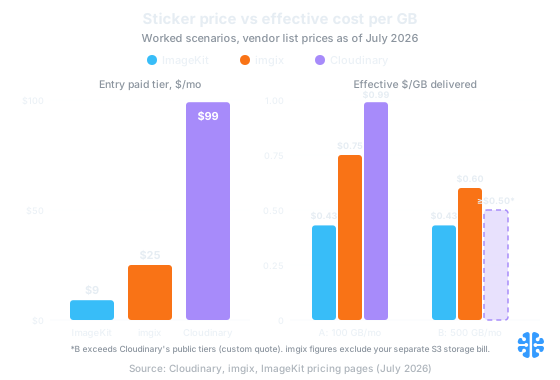
Sticker prices span 11x, but effective $/GB compresses; Cloudinary's scenario B cost is not publicly computable (vendor pricing pages: Cloudinary, imgix, ImageKit, July 2026).
Three observations from the table. First, ImageKit's per-GB model produces a nearly flat effective rate (about $0.43/GB) at both tiers: what you lose in volume discounts you gain in forecastability. Second, tiered credit plans create cliff effects: imgix at 900 credits pays for 1,875, and Cloudinary at 160 pays for 225. Your effective rate depends heavily on how close you land to a tier boundary. Third, and most important for budgeting: Cloudinary is the only one of the three whose cost at our mid-size scenario B cannot be computed from public information at all.
What users actually complain about
Each platform's weakness is the shadow of its design choice: Cloudinary's power reads as complexity and cost, imgix's minimalism reads as absence, ImageKit's value focus reads as polish gaps. These are recurring themes in G2 reviews of Cloudinary, imgix, and ImageKit as of July 2026, aggregate sentiment rather than verified product facts, and worth reading in the original before you buy.
Cloudinary reviewers return to cost at scale, difficulty predicting the credit system, documentation so extensive it overwhelms, and the jump from $0 straight to $99 with nothing between. That last complaint is verifiable on the pricing page itself: as of July 2026, no tier exists between the free plan and Plus at $99/mo (Cloudinary pricing).
imgix themes center on minimal asset management (which, in fairness, is the stated design), lock-in anxiety once imgix URL schemes are embedded across a site and its caches, mixed support experiences, and the absence of any free tier for small projects.
ImageKit draws the softest criticism of the three: a media library UI some reviewers find dated, storage and versioning limits, and an onboarding curve. It also carries the highest G2 satisfaction of the trio, roughly 4.7/5 versus about 4.4 for Cloudinary and 4.1 for imgix, per live G2 listings as of July 2026; ratings shift as reviews accumulate, so check the current pages before deciding.
On adoption: wmtips crawler data from February 2026 shows Cloudinary detected on roughly 1.4x more websites than imgix and about 5x more than ImageKit (wmtips). Treat that as detected deployments by one crawler, not market share: detection favors client-visible URL patterns and says nothing about revenue or workload size. The interesting tension is that the most-deployed platform has the middle satisfaction score, a familiar pattern wherever enterprise sales motion and developer sentiment diverge.
When is each one the right choice?
Choose on the two axes that actually differentiate them: how much platform you need beyond image delivery, and how much billing legibility you require. Sticker price is the least useful signal; as the worked scenarios show, workload shape moves the ranking around.
Choose Cloudinary when you genuinely need the whole platform: video transcoding at scale, a real DAM, AI tagging, and a large team working inside one system, with the budget maturity to negotiate Enterprise pricing rather than ride published tiers. The blended credit is a reasonable trade when your workload is truly mixed. If you are buying it for image resizing alone, you are paying platform prices for a utility.
Choose imgix when your assets already live in S3 or GCS, that must remain the single source of truth, and you want rendering as a stateless layer on top. Teams with strong infrastructure discipline get real elegance from the origin model. Go in with open eyes on the storage-weighted credits (cold libraries cost double per GB), the trial-only entry, and the migration cost of embedded URL schemes if you ever leave.
Choose ImageKit when cost predictability and fast time-to-value dominate: startups, mid-size sites, and anyone burned by an unforecastable credit bill. The forever-free 20 GB tier and the $9 entry make it the lowest-risk trial of the three, and the flat per-GB model is the only one here your finance team can audit with a calculator. Accept a lighter DAM and less enterprise surface in exchange.
Choose none of them yet if you have not measured what your images actually need. All three will happily auto-compress your library with generic settings, and generic settings are precisely how visual quality regressions ship, the failure mode we've documented in why blanket compression hurts your CMS. A delivery platform executes a policy; it does not tell you whether the policy is right. Decide on quality thresholds and measurement first, then buy delivery. Our position on how to run that evaluation, with holdout sets and perceptual metrics rather than vendor demos, is documented in how we benchmark, and it applies just as well to evaluating these three.
FAQ
Which is cheapest at scale: Cloudinary, imgix, or ImageKit?
In our worked scenarios using July 2026 published rates, ImageKit is cheapest at both tiers: about $43/mo versus $75 (imgix, plus your S3 bill) and $99 (Cloudinary) at 100 GB delivered, and roughly $213 versus $300 and a custom Cloudinary quote at 500 GB. Workload shape matters, though: heavy video or transformation loads shift the math, so rerun it with your numbers.
Does imgix have a free plan?
No. As of July 2026, imgix offers a 30-day trial with 100 credits, then paid plans starting at $25/mo (imgix pricing). It is the only one of the three without a permanent free tier: ImageKit offers 20 GB of bandwidth monthly forever-free, and Cloudinary's free plan includes 25 monthly credits (ImageKit, Cloudinary).
Can I use my own S3 bucket or storage with each platform?
imgix requires it: the product is a rendering layer over your existing S3/GCS origin, and you keep paying your cloud provider for storage. ImageKit supports both its managed storage and external origins, the most flexible arrangement of the three. Cloudinary's model centers on its own managed storage, which your credit allotment pays for at 1 credit per GB.
What happens when I exceed my Cloudinary credits or ImageKit bandwidth?
ImageKit meters transparent overages: $0.50/GB bandwidth on Lite, $0.45/GB on Pro, and $0.10/GB storage, as of July 2026 (ImageKit plans). imgix charges $0.25 per extra credit on Starter. Cloudinary's published path is upgrading tiers, and with nothing between $0 and $99, then $99 to $249, overruns tend to mean plan jumps rather than small metered charges (Cloudinary pricing).
Which image CDN is best for video as well as images?
Cloudinary has the deepest video capability of the three: its credit system explicitly prices video processing (500 SD or 250 HD seconds per credit as of July 2026), alongside transcoding and streaming features (Cloudinary pricing). ImageKit includes video units on paid plans (5,000 on Pro) and suits lighter video needs. imgix is images-first by design; heavy video workloads point elsewhere.