 Inverity
Medical Image Compression: DICOM and Diagnostic Risk
Date Published
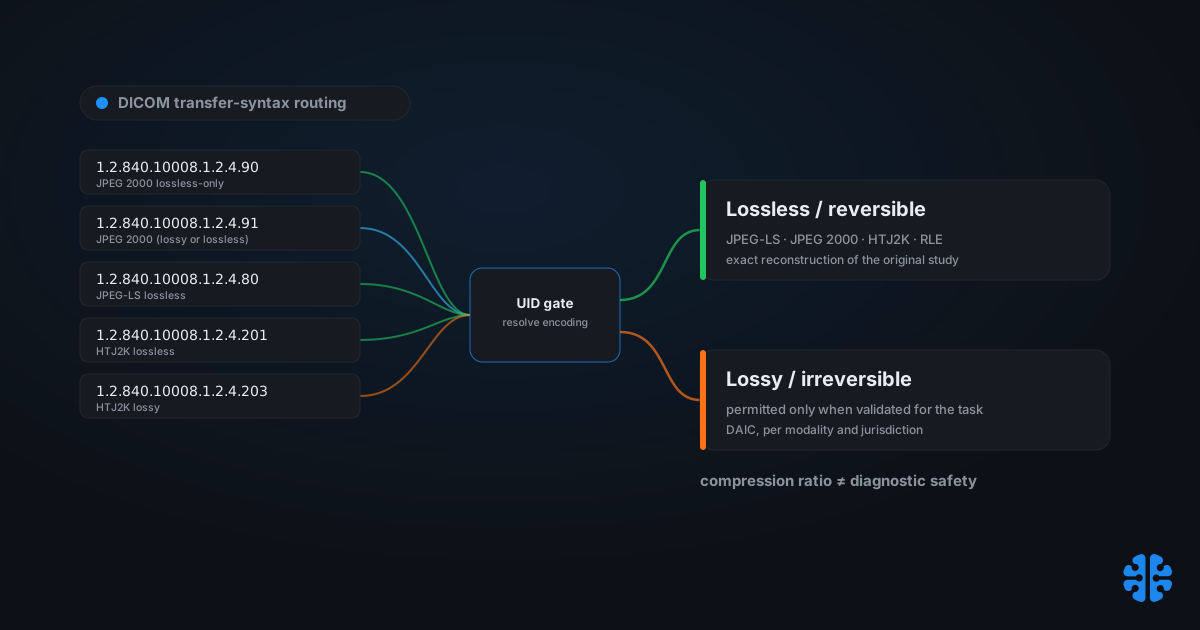
TL;DR >- DICOM PS3.5 defines transfer syntaxes that govern how pixel data is encoded, the authoritative registry for medical image compression, but it defines HOW compression is encoded, not WHETHER it is clinically allowed (DICOM PS3.5, NEMA).- Each codec has explicit lossless and lossy UIDs: JPEG 2000 lossless-only is 1.2.840.10008.1.2.4.90, and HTJ2K adds lossless (.201), lossless RPCL (.202), and lossy (.203) via Supplement 235 (DICOM PS3.5 §8.2.14).- The ACR-AAPM-SIIM standard defines "Diagnostically Acceptable Irreversible Compression," permitting lossy only when it does not affect the diagnostic task, and makes no general statement on the appropriate amount or type per modality (ACR-AAPM-SIIM Technical Standard).- Abdominal CT reaches a visually lossless threshold near 8:1 with 3D JPEG 2000, while mammography detection of subtle findings degrades at 40:1 and 80:1, so no single ratio is universally "safe" (RSNA Radiology, PubMed 17890355; RSNA Radiology mammography FROC).- HTJ2K keeps JPEG 2000's wavelet quality and lossless/lossy flexibility while delivering dramatically higher throughput, which is why PACS vendors are adopting it (DICOM Supplement 235).
Engineers new to medical imaging often ask one question and get a misleading answer. "Does DICOM allow lossy compression?" The honest reply is that DICOM is the wrong place to ask. DICOM is a container and encoding standard: it specifies precisely how a JPEG 2000 or HTJ2K bitstream is wrapped, labeled, and read. It does not, and was never meant to, decide whether a lossy image is acceptable for a given diagnosis. That decision belongs to national regulators and radiology societies, and their guidance diverges by country and by task.
Conflating those two layers, the encoding standard and the clinical policy, is the central mistake in most medical-compression writing. This post keeps them apart. First, the DICOM mechanics: transfer-syntax UIDs mapped to codecs. Then the engineering story of HTJ2K. Then the reconciled, and genuinely conflicting, society guidance, ending with why a compression ratio is a poor proxy for safety.
Does DICOM require lossless, or does it allow lossy compression?
DICOM permits both, because DICOM only describes encoding, not permissibility. PS3.5 defines transfer syntaxes that govern how pixel data is encoded, serving as the authoritative registry for medical image compression (DICOM PS3.5, NEMA). It offers lossless and lossy options side by side. What it deliberately does not do is state whether a lossy image is clinically appropriate; that judgment sits with regulators and professional bodies.
This distinction is not pedantry. A vendor can produce a fully DICOM-conformant lossy study that a national guideline forbids for primary diagnosis. The file is valid; the clinical use may not be. Permissibility is set outside the standard, by bodies like the FDA and under frameworks such as EU MDR, and it varies by country (ACR-AAPM-SIIM Technical Standard).
Why was lossless historically the default anyway? Three reasons compound: legal and regulatory discoverability of the "original" study, medico-legal risk, and the clinical fact that subtle low-contrast findings, microcalcifications, small nodules, thin fractures, live in exactly the high-frequency detail that lossy coding discards first. When a missed finding carries diagnostic and legal weight, exact reconstruction is the defensible baseline.
Citation capsule: DICOM PS3.5 defines transfer syntaxes that govern how medical pixel data is encoded, functioning as the authoritative registry for image compression in DICOM. Critically, the standard specifies how compression is encoded, not whether it is clinically permissible; that permissibility is determined separately by national regulators and radiology-society guidance, and varies by country (DICOM PS3.5, NEMA).
The lossless-when-it-matters principle runs through our complete guide to image compression and connects to what invertibility is and how it is used in image optimization.
The DICOM transfer-syntax UID map
A transfer-syntax UID is how a DICOM file announces exactly which codec and mode produced its pixels. Reading a study means resolving that UID before you can decode a single pixel. The UIDs are stable, registered strings, and each pins down a codec and whether it is lossless or lossy. JPEG-LS lossless is 1.2.840.10008.1.2.4.80 and its near-lossless (lossy) sibling is .81 (DICOM PS3.5 §10.5).
Transfer syntax | UID | Codec | Lossless / lossy |
|---|---|---|---|
JPEG Baseline | 1.2.840.10008.1.2.4.50 | JPEG (8-bit) | Lossy |
JPEG Lossless | 1.2.840.10008.1.2.4.70 | JPEG lossless | Lossless |
JPEG-LS Lossless | 1.2.840.10008.1.2.4.80 | JPEG-LS | Lossless |
JPEG-LS Near-Lossless | 1.2.840.10008.1.2.4.81 | JPEG-LS | Lossy (near-lossless) |
JPEG 2000 Lossless-only | 1.2.840.10008.1.2.4.90 | JPEG 2000 | Lossless |
JPEG 2000 | 1.2.840.10008.1.2.4.91 | JPEG 2000 | Lossy or lossless |
HTJ2K Lossless | 1.2.840.10008.1.2.4.201 | HTJ2K | Lossless |
HTJ2K Lossless RPCL | 1.2.840.10008.1.2.4.202 | HTJ2K | Lossless (resolution-first) |
HTJ2K | 1.2.840.10008.1.2.4.203 | HTJ2K | Lossy |
RLE Lossless | 1.2.840.10008.1.2.5 | Run-length | Lossless |
Sources: DICOM PS3.5 §10.5; DICOM PS3.5 §A.4.4; DICOM PS3.5 §8.2.14 / Sup 235; DICOM Library transfer-syntax registry.
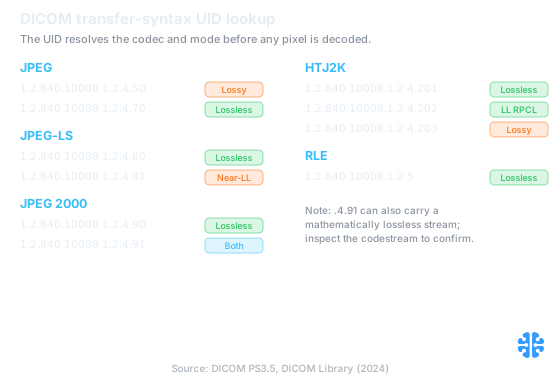
The UID resolves the codec and mode before any pixel is decoded (Source: DICOM PS3.5, DICOM Library).
Two implementation notes matter here. The .91 JPEG 2000 syntax is lossy-capable but can also carry a mathematically lossless stream, so the UID alone does not always tell you the effective mode; you may need to inspect the codestream. And RLE lossless (1.2.840.10008.1.2.5) is not a JPEG-family UID at all, which trips up parsers that assume the .4.x prefix. For the general lossless-format landscape behind these codecs, see lossless image compression formats compared.
What is HTJ2K, and why are PACS vendors adopting it?
HTJ2K is a drop-in successor to JPEG 2000 that trades the same wavelet transform through a far faster entropy coder. Standardized as ISO/IEC 15444-15 and brought into DICOM by Supplement 235, it delivers dramatically higher throughput than legacy JPEG 2000 at the same wavelet quality, keeping identical lossless and lossy flexibility (DICOM Supplement 235). The wavelet math is unchanged; the block coder is redesigned.
For engineers, that is the whole pitch. JPEG 2000 produces excellent quality and true scalable, resolution-progressive streams, but its arithmetic block coder is slow enough to strain real-time viewing of large studies. HTJ2K swaps in a high-throughput block coder that decodes and encodes an order of magnitude faster, without changing the wavelet coefficients or the quality-versus-size behavior. You keep the format's strengths and lose the latency.
The RPCL variant (UID .202) is worth calling out. Resolution-Position-Component-Layer progression orders the codestream so a low-resolution image appears first and refines, enabling resolution-first display for fast preview of huge images before the full data arrives (DICOM Supplement 235). For radiologists paging through gigapixel studies, that progressive behavior, at HTJ2K speed, is the freshest reason vendors are migrating.
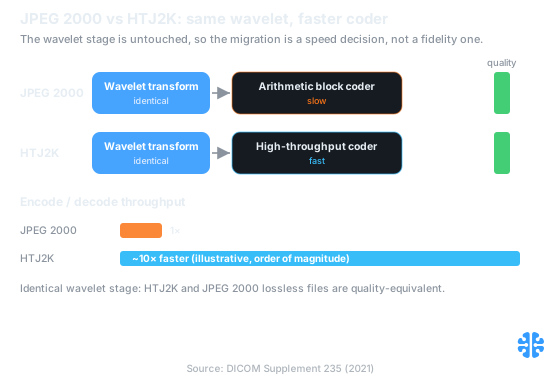
The wavelet stage is untouched, so the migration is a speed decision, not a fidelity one (Source: DICOM Supplement 235).
The subtle point most HTJ2K explainers miss: because the wavelet stage is untouched, an HTJ2K lossless file and a JPEG 2000 lossless file of the same image are quality-equivalent by construction. The migration is a performance decision, not a fidelity one. That decoupling of speed from quality is exactly the kind of separation we argue for in the measurement, not the model: making neural CT compression provable.
How do CAR, RCR, and ACR-DAIC differ on lossy compression?
They agree on the principle and diverge on the specifics, which is why quoting one as gospel is risky. The clearest convergence: irreversible (lossy) compression is permissible only when it has been validated not to affect the diagnostic task. The ACR-AAPM-SIIM standard formalizes this as "Diagnostically Acceptable Irreversible Compression" (DAIC), usable only under a qualified physician's judgment, and it pointedly makes no general statement on the appropriate amount or type of compression per modality or disease (ACR-AAPM-SIIM Technical Standard).
Other bodies have historically been more numeric, and less durable. The following comparison should be read with care: the CAR modality ratios below come from secondary literature and should be checked against the primary CAR standard before operational use, and the RCR figure has since been withdrawn.
Body | Approach | Representative guidance | Status |
|---|---|---|---|
ACR-AAPM-SIIM (US) | Task-based validation (DAIC) | No blanket ratio; lossy only if diagnostically validated, under a physician | Current |
CAR (Canada) | Modality-specific ratios | Approx. CT body 10-15:1, MR 16-24:1, CR/DR 20-30:1, ultrasound 8-12:1 (JPEG / JPEG 2000) | Secondary source, verify against primary CAR |
RCR (UK) | Single primary-diagnosis ratio | Approx. 15:1 recommended in 2008 | Withdrawn May 2018, not replaced |
Sources: ACR-AAPM-SIIM Technical Standard; CAR ratios via JIIM / Springer (secondary, verify against primary CAR standard); RCR 2008 figure and 2018 withdrawal via ESR / Insights into Imaging (secondary, confirm).
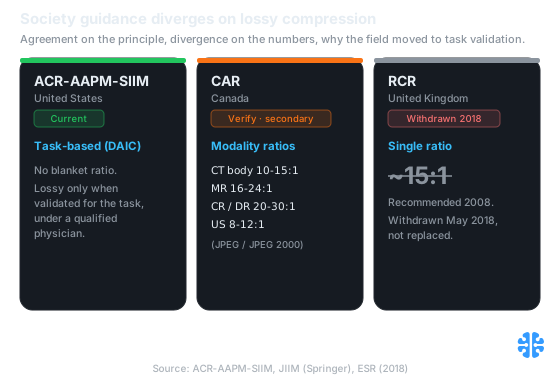
Agreement on the principle, divergence on the numbers, which is why the field moved to task validation (Source: ACR-AAPM-SIIM, JIIM, ESR literature).
The trajectory is telling. The UK's single 15:1 number, reportedly recommended for primary diagnosis in 2008, was withdrawn in May 2018 and not replaced (ESR / Insights into Imaging). Retiring a blanket ratio rather than updating it is itself evidence that fixed numbers age badly, and it is why the DAIC task-based philosophy has become the more defensible frame. This is a genuinely regulated domain; treat any single ratio you find, including the ones tabled here, as context-bound and jurisdiction-specific.
Why compression ratio is the wrong safety metric
A compression ratio tells you almost nothing about whether a diagnosis survives, because achievable quality at a given ratio depends on the image's own content. The same nominal ratio yields different fidelity on a noisy chest CT than on a clean mammogram, since the recoverable quality tracks image entropy, not the headline number (PubMed 17885201, "compression ratio is a poor metric"). Two studies at "20:1" are not equally safe.
The task-specific evidence makes this concrete. For abdominal CT, roughly 8:1 with 3D JPEG 2000 is a visually lossless threshold, and at low ratios the dominant effect is actually noise reduction, which can nominally improve some image metrics without adding diagnostic value (RSNA Radiology, PubMed 17890355). Mammography behaves very differently. In an FROC study, JPEG 2000 at 40:1 and 80:1 degraded detection of subtle findings against uncompressed figures-of-merit of about 0.80 for microcalcifications, 0.81 for masses, and 0.72 for both (RSNA Radiology mammography FROC).
Put those two results together and the lesson is unavoidable: a ratio that is comfortably visually lossless for one modality can erase the exact findings another modality exists to catch. We do not present any single ratio as universally safe, and neither should an engineering spec. The safe number is the one validated for your modality, your task, and your jurisdiction, and it is discovered by measurement, not assumed. This is the same argument we make in why file size is the wrong metric.
At Inverity we hold that a compression claim which cannot be checked against the diagnostic task is not a safety claim at all, which is why we frame medical compression around measured, task-specific fidelity rather than a headline ratio, the principle detailed in the measurement, not the model. For the neighboring high-stakes domains in this cluster, see ecommerce catalog compression at scale and map tiles and geospatial compression.
FAQ
Does DICOM allow lossy compression, or is medical imaging always lossless?
DICOM allows both. PS3.5 defines lossless and lossy transfer syntaxes side by side and specifies how each is encoded (DICOM PS3.5, NEMA). It does not decide clinical permissibility; that is set by national regulators and radiology societies and varies by country. A DICOM-conformant lossy file can still be disallowed for a given diagnostic use.
What are the DICOM transfer syntaxes for JPEG 2000, JPEG-LS, and HTJ2K?
JPEG 2000 lossless-only is 1.2.840.10008.1.2.4.90 and lossy-capable is .91 (DICOM PS3.5 §A.4.4). JPEG-LS lossless is .80 and near-lossless is .81 (§10.5). HTJ2K adds .201 lossless, .202 lossless RPCL, and .203 lossy (§8.2.14).
What is HTJ2K and why are vendors adopting it over JPEG 2000?
HTJ2K (ISO/IEC 15444-15) keeps JPEG 2000's wavelet transform but replaces the block coder, giving dramatically higher throughput at the same wavelet quality and the same lossless and lossy flexibility (DICOM Supplement 235). Its RPCL mode enables resolution-first progressive display, so vendors gain speed and fast preview without sacrificing fidelity.
What compression ratio is safe for CT, MRI, or mammography?
There is no universal safe ratio, and presenting one would be misleading. The ACR-AAPM-SIIM DAIC standard requires task-based validation and gives no blanket number (ACR-AAPM-SIIM). Evidence is task-specific: abdominal CT is visually lossless near 8:1 (PubMed 17890355), while mammography degrades subtle-finding detection at 40:1 and 80:1 (RSNA FROC).
What is Diagnostically Acceptable Irreversible Compression (DAIC)?
DAIC is the ACR-AAPM-SIIM concept that irreversible (lossy) compression is acceptable only when it does not affect the specific diagnostic task, as judged by a qualified physician (ACR-AAPM-SIIM Technical Standard). Notably, the standard makes no general statement about the appropriate amount or type of compression per modality or disease, pushing validation to the task level.